Post
by Eric Esche » Mon Mar 24, 2014 2:04 pm
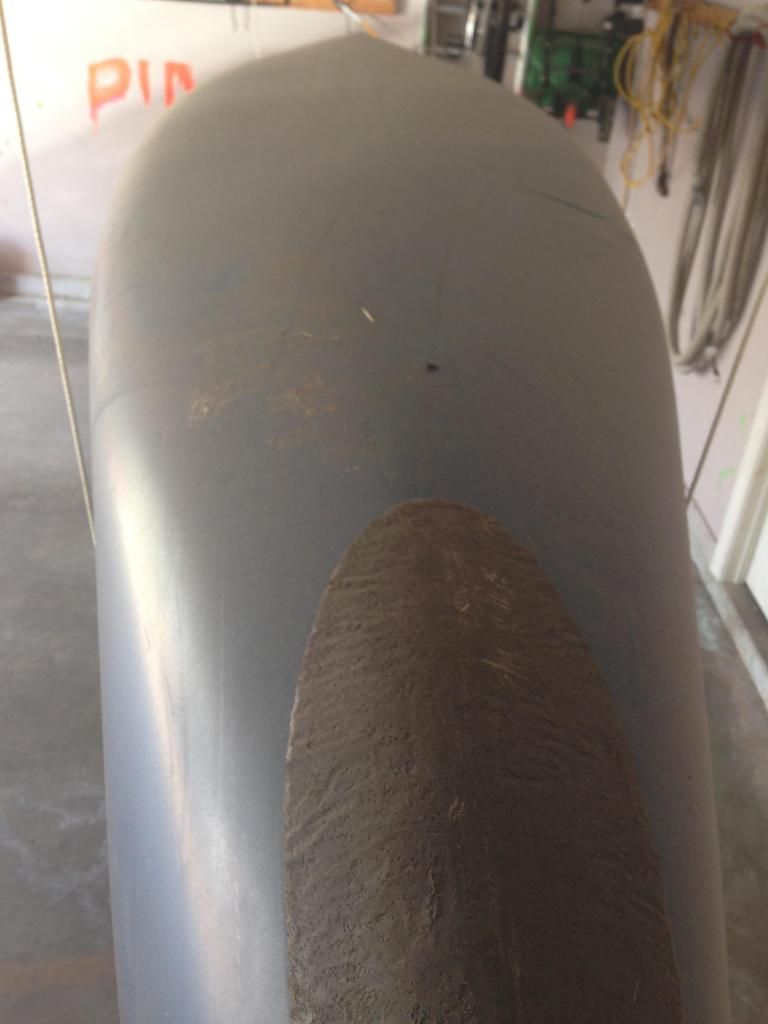
The "patch" you are showing us in the photo is in the location where one normally sees Kevlar Felt + Epoxy Resin "skid" or "grunch" plates. The width shown is not uncommon and there are commercially available patch kits out there just this size. I have them on one of my canoes and the original patch (Made by Jim Henry himself) held from early 1973 until 2012 before I patched the patch, and this canoe has seen a lot of heavy use over the years since I bought it used in 1974. Wider skid plates protect a wider area and seem to adhere better than skinnier ones. Without removing the patch (not desirable unless the skid plate is coming loose, it is about impossible to determine what it covers up, but if the patch is a good one, it probably does not matter, unless the damage is very major to the point of being structural or through and through, in which case, a patch on both sides is often used. More patches add more weight, but Kevlar felt patches rarely fail.
If the other end does not have a matching skid plate, you might want to add one for a cost of $10 (do it yourself with easy access to materials) to $100 (getting a quality shop to do it right)
If the raised edge of the patch creates problems due to rough edges or hanging on rocks like a kayak chine, the edge can be carefully ground down with a dremel until it is feathered and near flush, but I recommend you line the edge of the area you do not want ground with a few layers of tape until you are skilled in grinding with a dremel or you can gouge a ding in a millisecond. Nothing against this patch - it looks like 90% of the skid plates out there. Most serious canoeistsof Royalex or Royalite hulls consider a Kevlar skid plate a desirable upgrade.
A trick often used to get a smoother surface when patching with kevlar felt is to cover it with saran wrap and tape the edges into place after you squeegee out all the air bubbles and work the excess resin out to the edges to give a feathered edge. This can also slow by a few hours, some, (but not all) epoxy cure rates and the saran wrap may have to wear off later if not pretreated with a mold release agent. While sometimes "prettier", this does not make the patch any stronger, just smoother, and it might make the patch have slightly fewer ablative surfaces to wear off on rocks, but it is unlikely you would ever notice in the first 20-30 years.
Covering all adjoining areas with tape and saran wrap or plastic sheeting prior to patching helps the patch job look neater/prettier with fewer resin drips and smears.
As to the worth of this canoe......... I'd need to see more detailed pictures to nail it tighter, and folks always tell me I under value other people's boats for sale. On the back side of that comment, no one has ever complained that I overcharged them on one I sold. They usually run home fast thinking that they got a heck of a steal. Wide ball park range to me for this boat would be $400-$750, depending on many factors
Here's my thinking. I see what looks like a fair scrape across the bottom on the right, and being Royalite. It may need a patch there. I admit I have a bias against Royalite. The weight savings vs regular Royalex are so little and the thickness of the outer layer is "where the rubber meets the road" as they say in the tire commercials. If I wanted lighter weight, I'd buy an older Kevlar boat. It would be good to know the serial number, so that you would know what year it was made. Older is not necessarily bad with Royalex, but Royalite has not been around that long, and what vinyl is there is thinner so it wears out faster, and there is less there for the sun to oxidize and degrade. Can't see from the photo how oxidized the outer layer is, nor the condition of the gunnels, seats, and thwarts and what they are made of. Just because it is in a covered area now, does not mean it always has been, unless you can see it up close, and know what to look for. For sure - Nova is a desirable manufacturer, and the Prospector a good all round model, a desirable model not going to be made anymore, if that is what you like. Years of accumulated grime can look like severe oxidation of the outside vinyl layer, but a cleaning with Dupont 303 will help in any case and may show it is just grime. While wood gunnels are desirable to most folks, they are also labor intensive for as long as you own it and want to keep it. Aluminum gunnels are probably the most care free, but also tend to be a tad heavier. If you have a Royalite hull, it probably has plastic gunnels which are the cheapest option. Value also depends on WHERE it is for sale and what it takes to get it to you. If it is in an area where there are lots of boats for sale, value locally may go down. In an area where there is not much boating, prices asked can see both extremes.
If you do not get this canoe, you might let Okieboater (David Reid) know the details on it, as he is looking for a Prospector.
Eric Esche